Is Etsy legit and safe? How to shop without getting scammed



Etsy is a popular online shopping platform known for unique, personalized, and hard-to-find products. While millions of buyers use Etsy successfully each year, no online marketplace is completely risk-free. Etsy's open marketplace model, where independent sellers list and ship their own items, also means the buyer's experience depends partly on the sellers you choose.
Is Etsy legit?
Yes, Etsy is a legitimate e-commerce company founded in 2005. It is publicly traded under the ticker ETSY, and its Securities and Exchange Commission (SEC) filing reported that the Etsy marketplace connected about 86.5 million active buyers with 5.6 million active sellers as of December, 2025.
The important distinction is that Etsy is the marketplace, not the seller. It provides the platform that connects buyers and sellers, while each shop is responsible for its own listings, shipping timelines, and return policies.
This doesn't make Etsy unsafe. It means buyers should understand that Etsy functions more like many independent shops under one roof than a single retailer with uniform stock, service, and returns across every listing.
How Etsy works as a marketplace
A typical Etsy purchase involves three parties: the buyer, the seller, and Etsy itself. The buyer pays through Etsy's checkout, the seller fulfills the order, and Etsy provides the systems behind the transaction, including payments, messaging, reviews, marketplace policies, and dispute handling.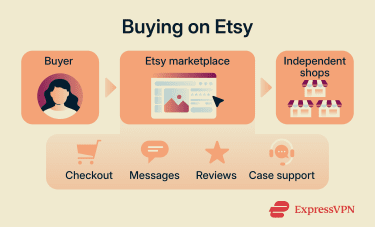
Etsy doesn't allow everything to be sold. According to Etsy's Creativity Standards, items must incorporate a human touch and fit one of four categories:
- Made by a seller: Physical items made by the seller by hand or with personal or computerized tools, like a 3D printer, CNC machine, or Cricut. Etsy states that computerized-tool items must be based on the seller's original design.
- Designed by a seller: Original designs offered as digital downloads or produced by a disclosed third-party production partner.
- Handpicked by a seller: Vintage items at least 20 years old, items from nature, and certain curated collections, such as themed gift baskets.
- Sourced by a seller: Craft and party supplies, plus buyer-personalized items made with the buyer's custom text or image.
Etsy displays the relevant category on each listing so buyers can see at a glance how the item was made or acquired.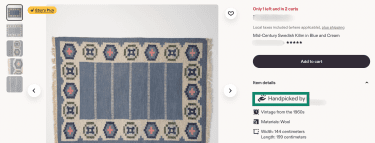
This model gives buyers access to unusual, custom, and independent products. It also means the buying experience can vary from shop to shop. Some shops provide detailed listings, responsive communication, and clear shipping expectations, while others may provide less detail.
Is Etsy safe to buy from?
Etsy provides marketplace tools and buyer protections that make transactions more structured than informal off-platform purchases. The buyer's experience still depends in part on which shop they're buying from, so the rest of this article covers both sides: what Etsy does to protect buyers and what buyers can check before purchasing.
How Etsy protects buyers
Etsy's checkout, refund coverage, and case system are designed to keep transactions on the platform and provide a structured process for certain order problems.
Etsy Payments
Etsy Payments is the platform's checkout system. Depending on the buyer's location and the seller's setup, Etsy checkout may support credit and debit cards, bank account payments, Etsy Gift Cards, Etsy Credits, Etsy Coupons, PayPal, Apple Pay, Google Pay, certain bank transfer services, and country-specific options such as Klarna.
The main security benefit is that payment details flow through Etsy rather than directly to the seller. According to Etsy's Payments Policy, Etsy maintains records associated with Etsy Payments transactions and doesn't pass secure data, such as credit card numbers or bank account information, to sellers. Etsy states that sellers receive shipping information and limited buyer account and order details needed to complete the order.
Purchase Protection
The Etsy Purchase Protection program covers qualifying orders when an item doesn't arrive, arrives damaged, arrives more than a week after the maximum estimated delivery date window provided at checkout, or differs significantly from the item description or photos.
According to Etsy's Case Policy, buyers receive a full refund for qualifying cases, including taxes and shipping costs collected on Etsy. Buyers may choose to receive the refund to the original payment method or as Etsy Credit.
For physical items and digital items ready for immediate download, buyers can open a case after the estimated delivery date has passed and 48 hours have passed since they sent the seller a Help with Order request. Etsy's help page states that the case window is 30 days from the order's estimated delivery date.
Etsy's protection limitations
Unless required by law, Purchase Protection and Etsy's case system have some clear boundaries. Etsy's Cases Policy states that the case system doesn't apply to transactions not processed through Etsy Payments, including offsite payments and orders paid through Standalone PayPal, or to items purchased in person.
It also doesn't apply if the buyer misses the case window, if checkout details were changed through Messages or other informal channels, if the item has been altered, used, worn, washed, or discarded after receipt, or if the item is returned without an agreed return process.
Other cases hinge on whether the listing was inaccurate or whether the item simply didn't meet expectations. For example, Purchase Protection applies if a ring advertised as sterling silver arrives in a different material, since that's not as described. It doesn't apply if the ring matches the listing, but the buyer doesn't like how it looks in person.
Custom orders involving buyer-supplied items deserve extra care. Etsy's Buyer Policy states that when a buyer sends their own item to a seller for modification, the buyer assumes risk for that item during shipping and while it's in the seller's possession. If a qualifying issue arises, Etsy may reimburse only the modification fee, not the value of the original item.
How to tell if an Etsy seller is legit
A legitimate Etsy seller usually leaves a clear trail: consistent and recent reviews, detailed listings, realistic photos, transparent policies, and direct communication. None of these checks is conclusive on its own, but together they provide a useful picture of whether a shop appears consistent and accountable.
Check reviews, ratings, and sales history
Reviews are among the most visible signals buyers use to evaluate an Etsy shop, but the content matters more than the number alone. Etsy's Review System help page states that a shop's review score is a recency-weighted average of its star ratings. Reviews from the past 12 months carry the most weight, and each rating's weight decreases by half each year.
What to do before buying:
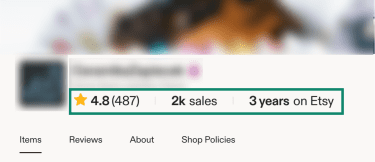
- Open the shop page to review visible shop signals: Total sales count, number of reviews, star rating, and how long the shop has been on Etsy. These signals can help show whether the shop has an established sales history, a roughly proportional review count, a strong recent rating, and enough activity to build a track record.
- Read recent reviews rather than only the top ones: Start with lower-rated reviews to see whether the same problems recur, and look for buyer-uploaded photos or videos along with specific details about quality, packaging, sizing, and delivery.
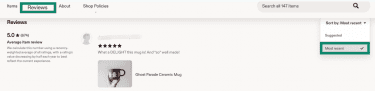
Specific reviews are usually more useful than vague ones. A review that mentions the material, fit, packaging, or delivery time gives more context than a short comment with no detail about what was bought.
Read shop policies and product details
Shop policies explain what happens after checkout. Each shop sets its own policies, which Etsy organizes into sections, such as returns and exchanges, cancellations, privacy, and other fixed policy details. Together, the shop policies, listing details, and shipping information should explain processing time, shipping, returns, exchanges, cancellations, and any rules for custom orders. Clear policies reduce ambiguity if a buyer needs to ask about a delay, return, exchange, or custom order.
In the listing itself, read the full description: size, color, material, quantity, and any customization details. Check where the item ships from and whether the delivery estimate makes sense for that origin.
Compare the photos with the written description. Watch for signs that the photos may not be original to the shop, such as mismatched backgrounds, inconsistent photo styles, or watermarks from another shop.
Shipping details deserve attention too. A long delivery window is normal for made-to-order or international items. It becomes more questionable when the listing claims a product is local, handmade, or ready to ship, but the delivery estimate appears inconsistent with those details.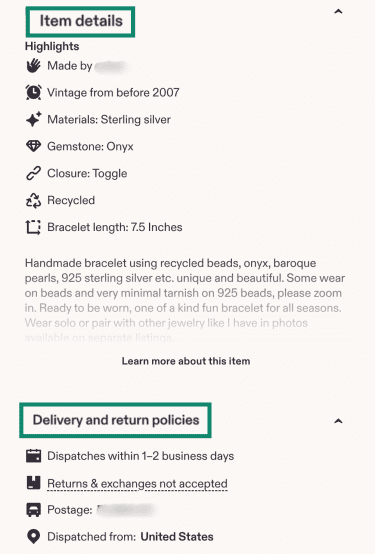
Read more: How to tell if an online store is legit: 12 clear signs to check.
Ask the seller questions before you buy
For custom, expensive, or time-sensitive orders, a quick message can clarify important details before checkout. Ask something specific enough that the seller should be able to answer from the listing or production details: material, sizing, production time, personalization options, or packaging. Open the listing and select Message seller or a similar option to contact the seller.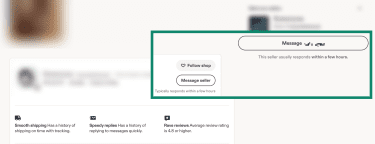
Keep the conversation inside Etsy Messages. Etsy's Buyer Policy says buyers should keep order-detail communication on Etsy via Messages, and Etsy's Off-Platform Transactions Policy says transactions initiated on Etsy may not be completed off Etsy. Etsy also states that off-platform transaction behavior can expose users to fraud or scams. A clear answer that matches the listing is a useful consistency signal, while pressure to move the conversation or payment off Etsy should be treated as a red flag.
Scam tactics to watch for on Etsy
Like any large online marketplace, Etsy can be targeted by scammers who try to exploit buyers, sellers, or platform features. Etsy sets marketplace policies for sellers, provides tools to report items or shops that may not meet those policies, and states in its Payments Policy that it may verify seller information to help safeguard marketplace integrity and reduce the risk of fraud. Etsy also publishes guidance for identifying and reporting phishing attempts, but buyers may still encounter fraudulent listings, misleading product claims, or impersonation attempts.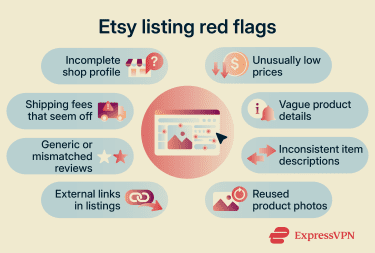
Some of the most common Etsy scams include:
- Fake shops and no-delivery scams: Some scammers may create shops using copied product photos, vague descriptions, or unusually low prices to attract buyers. While shipping delays can happen for legitimate reasons, repeated delays, inconsistent updates, or tracking information that doesn't match the destination may indicate a problem.
- Off-platform payment requests: A seller asking for payment outside Etsy is a major red flag. Requests to pay via gift cards, wire transfers, cryptocurrency, QR codes, or third-party payment apps can make disputes more difficult to resolve and may not be covered by Etsy's buyer protections.
- Counterfeit or misleading listings: Some listings may falsely present items as handmade, vintage, branded, locally made, or otherwise different from what is actually being sold.
- Phishing emails and fake Etsy websites: Scammers may impersonate Etsy, sellers, or customer support to steal account credentials or payment information. These messages often create a sense of urgency and may contain suspicious links, use unusual formatting, include QR codes, or ask for passwords, payment details, or verification codes. Etsy says suspected Etsy phishing emails can be forwarded to ReportPhishing@etsy.com.
Also read: How to check if a website is safe.
How to shop more safely on Etsy
A few simple habits can help reduce the risk of scams and other problems when shopping on Etsy:
- Use Etsy checkout: Complete purchases through Etsy's official website or app. Transactions made outside the platform may not be covered by Etsy's buyer protections.
- Keep messages on Etsy: Use Etsy Messages for order details, questions, and updates. This keeps a platform record that may be relevant if a dispute arises.
- Compare prices carefully: A low price isn't always a red flag, but listings priced far below similar items may warrant extra scrutiny.
- Save order records: Keep receipts, tracking information, seller messages, and screenshots of the listing. These records can be useful if an item doesn't arrive or differs from the description.
- Protect your account: Use a unique password and enable two-factor authentication (2FA) to reduce the risk of unauthorized access. Go to etsy.com/your/account/security, click Turn 2FA on, and choose SMS, phone, or an authenticator app. Etsy's Make Your Account More Secure documentation describes authenticator apps as the more secure option.

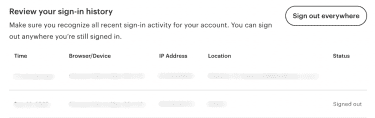
- Review your sign-in history: In the security documentation, Etsy also states that it shows up to 10 of your most recent sign-ins. If you see a sign-in you don't recognize, sign out of that session and remove any unrecognized third-party app connections. Etsy also recommends changing your password if you think your account may have been compromised.
For a broader checklist, see our guide to safe online shopping.
What to do if something went wrong with your Etsy order
If an Etsy order doesn't arrive, arrives damaged, or doesn't match the listing, you should use Etsy's order support flow. Keeping the issue within Etsy gives the platform access to order records, seller messages, listing details, and tracking information that may be relevant if Etsy reviews a case.
Open a case through Etsy
To request Etsy's help through Purchase Protection, you generally need to start with the order support flow rather than waiting for the program to apply automatically.
- Log into your Etsy account and go to Your account > Purchases or Purchases and reviews.
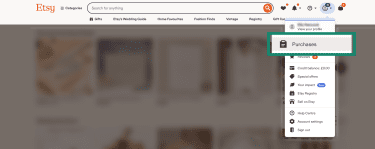
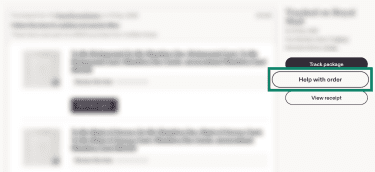
- Find the affected order and select Help with order.
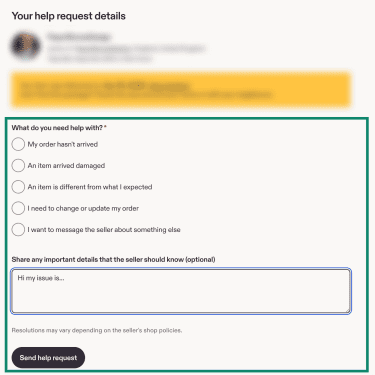
- Write the seller a clear message explaining the issue and the preferred resolution. Once done, click on the Send help request button.
If the seller doesn't resolve the issue within 48 hours and the order is eligible for a case, you can ask Etsy to step in.
- Return to Purchases and reviews in your Etsy account.
- Select the affected order and click Help with order or Open a case, depending on what appears.
- Select the reason you need help from the available options.
- If prompted, select how you'd prefer to receive your refund (if eligible).
- In Let us know what went wrong, add supporting details about the issue.
- Submit the case to Etsy.
Report a suspicious item, shop, or message
Reporting is separate from opening an order case. It is used to flag items or shops that may violate Etsy's policies, such as misleading listings, counterfeit or unauthorized goods, or other prohibited content. Etsy's Report an Item or shop page states that users can submit a confidential report from the listing page or shop page if they suspect an item or shop doesn't comply with Etsy's policies.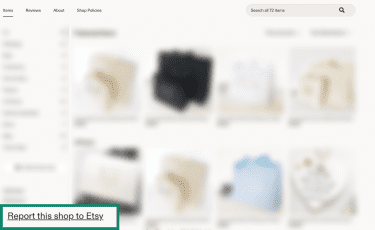
This is useful when a listing, shop, or message appears deceptive, suspicious, or inconsistent with what Etsy allows. It helps Etsy review the report and take action if necessary.
Contact your bank or card issuer (if needed)
If the issue can't be resolved through Etsy or if payment was made outside Etsy's checkout system, the bank or card issuer may be the next point of contact. If a chargeback has already been filed, Etsy states that it can't issue a refund for that transaction.
Use the phone number on the back of your card, your bank's official app, or the payment provider's official website. Have the transaction date, amount, seller name, Etsy order details, screenshots, and any case history ready.
Credit cards may offer chargebacks in certain situations, but deadlines and eligibility rules apply. Debit card protections vary by bank and country, so ask what options and deadlines apply. Gift card payments are often harder to recover, but the company that issued the gift card should still be contacted promptly with the card, receipt, and any available proof.
Learn more: What is credit card fraud, and how do you protect yourself?
FAQ
Is Etsy safe for debit or credit cards?
Can scams occur on Etsy?
How do I know if an Etsy shop is real?
What happens if my Etsy order never arrives?
Does Etsy refund buyers?